
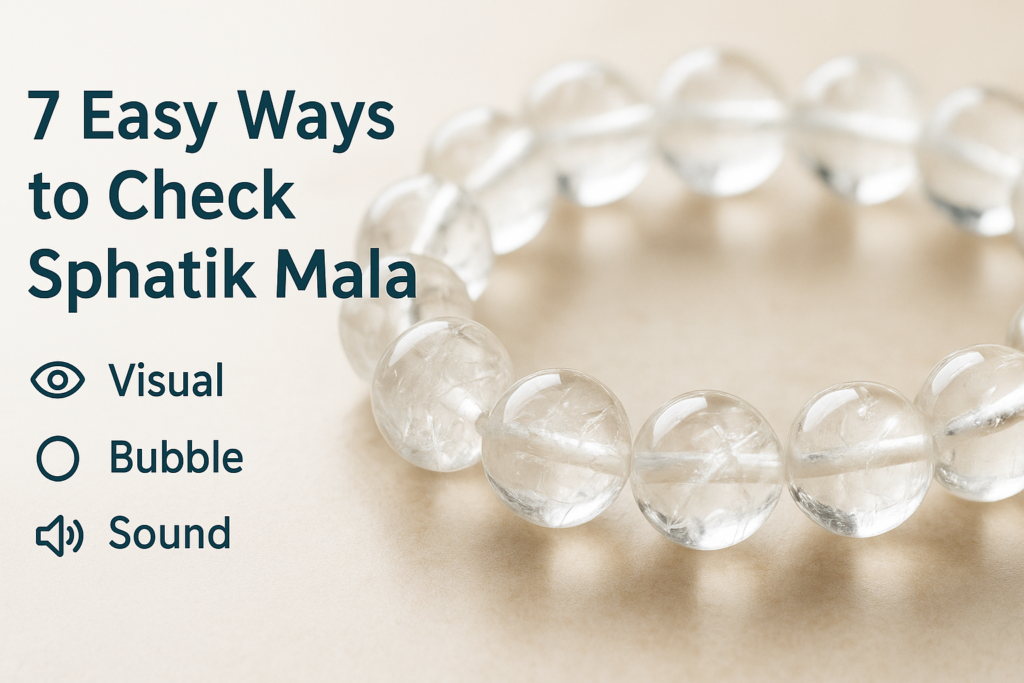
Looking for a genuine and Original Sphatik Mala? You’re not alone! This beautiful crystal rosary is loved for meditation, focus, and positive energy. But the Biggest Problem here is that lots of fake Mala Sellers are out there. If you did not check the Originality, you might end up with glass or plastic beads instead of real quartz crystal.
Fake malas won’t give you the true benefits, and honestly? It’s just disappointing.
Don’t worry – spotting a real Sphatik Mala isn’t hard. You don’t need a lab or special tools.
In this guide, I’ll show you 7 easy, practical ways anyone can check their mala at home. Let’s make sure you get the real energy boost you deserve!
The Spiritual Significance of an Original Sphatik Mala
Before we dive into the tests, let’s understand why authenticity is so crucial.
A Sphatik Mala is more than just a string of beads. It’s a tool for meditation, a conductor of energy, and a symbol of purity. The word “Sphatik” comes from the Sanskrit word for crystal, signifying its transparent and pure nature. In Hinduism, it’s associated with Goddess Saraswati, the deity of knowledge and wisdom, and is believed to bring clarity, peace, and focus.
Wearing or meditating with an authentic Sphatik Mala is said to calm the mind, reduce stress, and promote a sense of spiritual awakening. The beads are often used for counting mantras, and their cool touch is believed to absorb excess heat from the body, leading to a balanced state. This is why a fake, which lacks the natural vibrations and coolness of real crystal, can’t provide the same profound benefits.
7 Easy Ways to Test Your Sphatik Mala
The Temperature Test: The Easiest and Most Reliable Method
The most straightforward way to check for authenticity is to feel the mala. Sphatik is a natural crystal and, like other stones, it has a naturally cool temperature.
- How to do it: Hold the mala in your palm for a few minutes. A genuine Sphatik Mala will remain cool to the touch, even after being held.
- What to look for: If the beads quickly warm up to your body temperature, it’s a strong indication that they are made of glass or plastic. Glass and plastic are poor conductors of heat and will readily absorb your body heat, becoming warm. A real crystal, on the other hand, will feel cool and solid.
This simple test is often the first and most effective step in identifying a fake. The natural crystalline structure of Sphatik makes it feel distinctly different from any artificial material.
2. The Weight Test: Feeling the Density
Genuine Sphatik beads have a certain weight and density that is difficult to replicate with lighter materials like plastic or even some types of glass.
- How to do it: Hold the mala in one hand. If possible, compare its weight to a known genuine crystal or a similar stone of the same size.
- What to look for: A real Sphatik Mala will feel heavy and substantial for its size. Plastic beads, in contrast, will feel surprisingly light. While some types of glass can be heavy, they often lack the unique solid feel of a natural crystal. The density of quartz is higher than that of most common imitations, giving the mala a reassuring heft.
3. The Clarity and Inclusion Test: Looking for Imperfections
A common misconception is that a real Sphatik Mala should be perfectly clear, like a piece of flawless glass. However, the opposite is often true. Natural crystals, including Sphatik, often contain small inclusions, fissures, or tiny air bubbles.
- How to do it: Hold a single bead up to a light source. Use a magnifying glass if you have one.
- What to look for: Look for natural imperfections within the crystal. These can appear as wispy lines, small cracks, or microscopic air bubbles that are trapped within the stone. These are signs of its natural formation over thousands of years. Conversely, perfectly clear, flawless beads that have no internal flaws are often a red flag, as they are most likely made of glass. However, beware of imitations that intentionally add fake bubbles to glass. The bubbles in glass are usually perfectly spherical and uniform, while natural bubbles or inclusions in crystal are irregular and unique.
4. The Scratch Test: Hardness is a Key Indicator
Sphatik (quartz) is a relatively hard mineral, ranking at 7 on the Mohs scale of hardness.
This means it can scratch other softer materials.
- How to do it: Find a piece of regular glass or a metal object like a key. Try to gently scratch a small, inconspicuous part of one of the mala’s beads (perhaps on the side of the hole).
- What to look for: If the bead is genuine Sphatik, it will scratch the glass and will be unscathed by the key. Glass is softer than quartz and will show a scratch. A key, made of steel, is also generally softer than quartz. Be very careful with this test, as it can damage the mala if not done properly. A fake mala made of glass will be scratched by the key, and a plastic mala will be easily scratched by almost anything.
5. The Sound Test: Listening to the Tone
When two genuine Sphatik beads are tapped together, they produce a distinct, crisp sound.
- How to do it: Gently tap two beads of the mala against each other.
- What to look for: A real Sphatik Mala will produce a sharp, high-pitched, ringing sound, similar to the sound of two small stones clinking together. This is due to the dense, crystalline structure of the quartz. A mala made of glass will produce a duller, clunky sound, while a plastic mala will produce a very muted, soft sound. This test requires some experience to differentiate, but once you’ve heard the sound of a genuine Sphatik, it becomes much easier to identify.
6. The Magnification Test: Distortion Through a Crystal
This test is a classic method used to distinguish real crystals from glass.
The crystalline structure of quartz causes light to refract in a specific way, leading to a unique kind of magnification.
- How to do it: Place a bead on top of a line of text or a small diagram.
- What to look for: Look at the text through the bead. If it’s real Sphatik, the text will appear slightly distorted or doubled. This phenomenon is known as birefringence, and it’s a characteristic of many natural crystals. Glass, being an amorphous solid, lacks this crystalline structure and will show the text as clear and undistorted, similar to looking through a simple magnifying glass.
7. The Bubble Test: A Closer Look at the Flaws
While we touched on this in the clarity section, it’s worth a dedicated look. The type and shape of air bubbles are a major differentiator between natural crystal and man-made glass.
- How to do it: Examine the beads under a bright light source, preferably with a magnifying glass.
- What to look for: Natural air bubbles (inclusions) in Sphatik are often irregularly shaped, elongated, or look like tiny wisps. They are rarely perfectly round. In contrast, bubbles in man-made glass are typically perfectly spherical, uniform in size, and can appear in rows. These are a direct result of the manufacturing process. If you see perfectly round, evenly spaced bubbles, it’s a very strong indicator of a glass imitation.
When to seek professional certification
If the Sphatik mala is expensive, intended for resale, or you want certainty, ask for a gemological report from a recognized laboratory or a certified gemologist. Labs use non-destructive methods (refractive index, spectroscopy, high-power microscopy) to produce reliable certificates. Make sure the certificate includes item measurements or reference photos that match your mala
Final Words
Checking your Sphatik Mala doesn’t need to be complicated.
Use these 7 simple checks – look for imperfections, feel the coolness, check the weight, hunt for bubbles, do a gentle scratch test (if comfortable), try a UV light, and always think about the price and seller.
Finding a real Sphatik Mala connects you to a beautiful, natural energy tool. Don’t settle for a fake! Use these tips, buy from someone you trust, and enjoy the clear, positive vibes of genuine quartz crystal. Your meditation and focus deserve the best.
Found this guide helpful? Share it with a friend who loves crystals! Have a question or a story about finding a real Sphatik Mala? Tell us in the comments below – let’s chat!
.